
A work must have a birth certificate
- ckle

- 1 day ago
- 3 min read

They are musicians, visual artists, publishers. They come from Cotonou, Dakar, or Abidjan. What do they have in common? Boundless creativity — yet a persistent difficulty in making a living from it. It is from this paradox that the panel “Creative Economy & Industrialization of the Arts: Business Models and Value Chains,” held during the 4th edition of the Festival International des Arts du Bénin (FINAB), was born.
For an agency like CKLE, which supports organizations, entrepreneurs, and public actors in structuring their strategies and ecosystems, the issue was not merely cultural. It was systemic: how can creativity be transformed into an organized economic sector? How can we move from scattered initiatives to coherent value chains? How can artistic passion be aligned with economic viability?
At a time when cultural and creative industries (CCIs) are increasingly presented as a driver of growth in West Africa, this panel emerged as a critical space to understand structural bottlenecks and identify levers for industrialization. For CKLE, it was not simply about covering a cultural event, but about analyzing a strategic debate on the economic transformation of a sector with immense potential.
From creation to value : key insights from the panel
Moderated by Romuald Houesse, a key player in the cultural sector, the discussions quickly highlighted a central tension : Africa does not lack creativity or talent, but it struggles to structure its value chains.

Artist-producer Didier Awadi established a fundamental principle: legal formalization is the first step toward any form of industrialization. “A work must have a birth certificate,” he reminded the audience. In other words, without declaration, protection, and contractual control, there can be no viable economy.
He emphasized the importance of tools provided by the World Intellectual Property Organization (WIPO), particularly the CLIP platform, to help creators understand and manage their contracts. The message was strategic: intellectual property is the invisible infrastructure of creative value.
This idea of infrastructure was further developed by Alain Laerond, international technical expert in CCIs. He stressed that the “creative economy” is not a homogeneous entity but a set of multiple ecosystems driven by actors whose primary motivation is artistic. Creators, he noted, are first and foremost driven by passion. The economic dimension is not their natural entry point. Yet the economy of a work begins at its creation and expands through its distribution. And it is precisely distribution that remains the weak link. Many secure funding to produce but struggle to access effective dissemination channels, trapping them in a cycle of production without growth. The reflection initiated by ADAC Bénin on the creation of distribution spaces and tools illustrates the need to invest in this missing infrastructure.
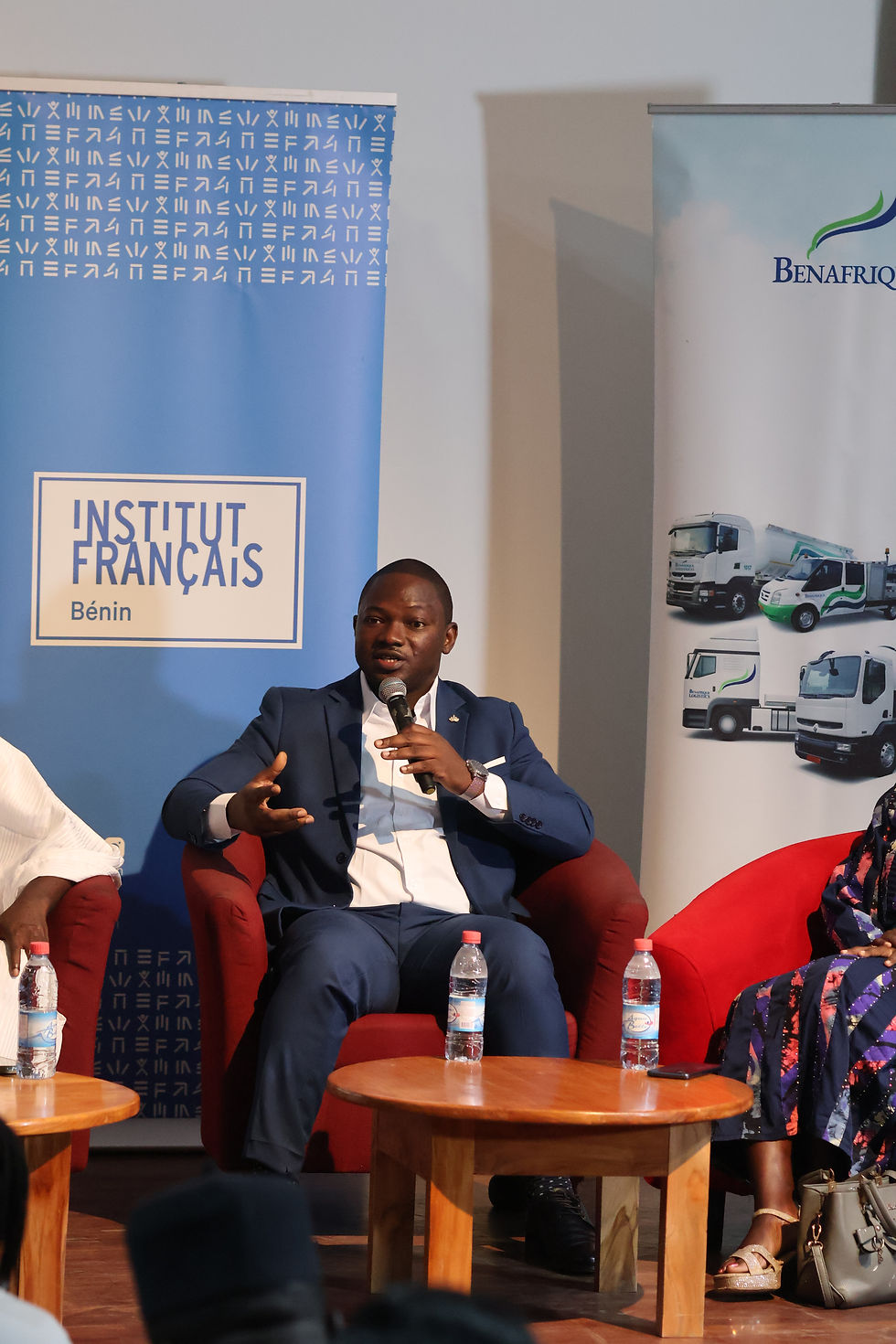
Vamossa Diomandé, Network Manager at HIT Radio Africa, offered a more macro-level perspective. In his view, Africa’s creative economy remains at an embryonic stage — not due to a lack of potential, but because of organizational deficits.
To generate value, actors must structure themselves legally, analyze their competitive environment, and develop a clear strategy. “An idea without strategy is empty,” he stated. His position echoes a core concern for CKLE : creativity alone is not enough; it must be supported by systems and strategic choices.
Finally, Jéronime Zanmassou, PhD in economics and heritage management, reminded the audience that wealth creation in the arts is rooted in identity — in heritage. Heritage feeds the various branches of the cultural industry, enables differentiation, and becomes an economic resource in its own right. Examples such as the Mur du Port in Cotonou or the Vodun Days demonstrate how heritage can generate opportunities for numerous creatives. Yet once again, dissemination remains a structural challenge, and digital technology appears to be a key driver for promotion and expansion.
A matter of value chains, not just talent

This panel confirmed a strong intuition : the challenge facing CCIs in West Africa is not creation. It lies in structuring the value chain — creation, protection, production, distribution, monetization. For CKLE, this reflection goes beyond the cultural sector. It raises broader questions about the ability of African ecosystems to transform their creative and symbolic capital into sustainable economic power.
Industrializing the arts does not mean stripping creation of its essence ; it means providing it with the tools to survive, circulate, and generate value.
At FINAB 2026, this panel offered far more than a sectoral exchange. It laid the groundwork for a strategic conversation on the economic engineering of culture. And it is precisely this conversation that CKLE intends to continue documenting, analyzing, and supporting.


Comments